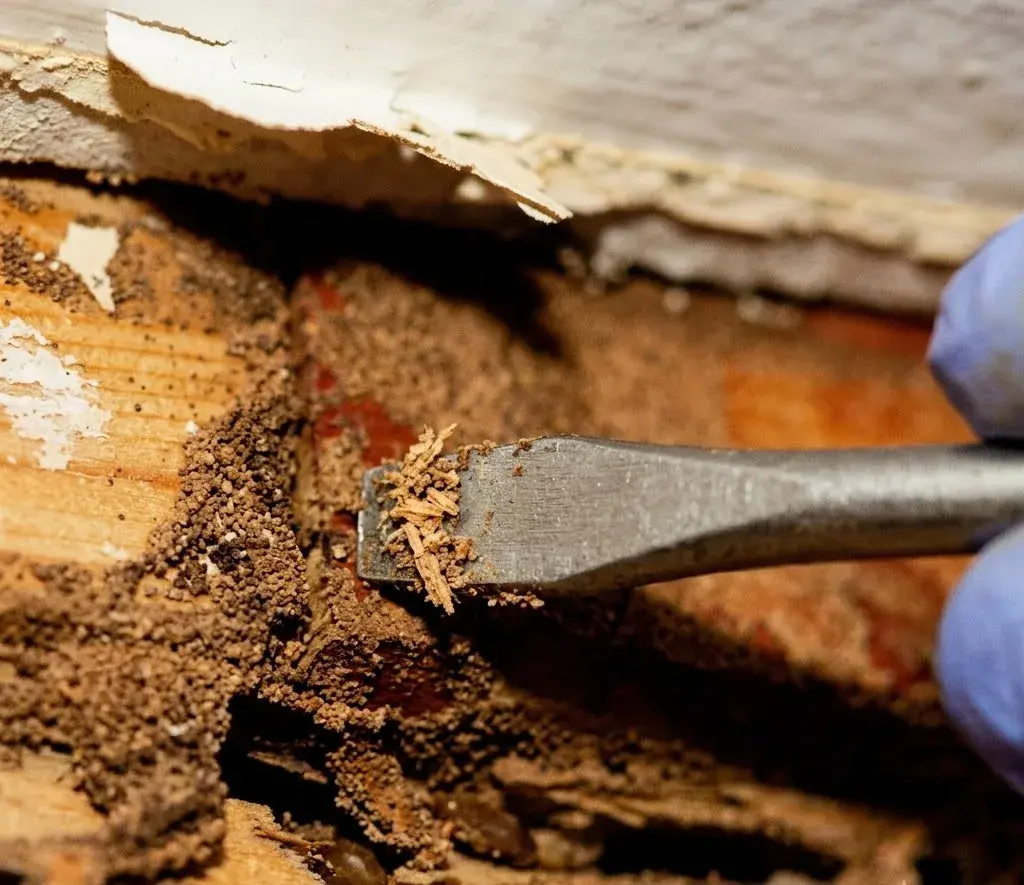
A scatter of small round holes, punched through a floor joist or a subfloor, a stair tread, some old length of trim, with a modest pile of powder gathered beneath. What made them was never really the question. Whether anything still lives in there is. Holes like these last precisely as long as the timber does, meaning a house can carry the identical set for forty years with not one live insect anywhere in it, and what separates the two possibilities costs a rag plus three weeks of patience.
Clean it, date it, then look again
That is the entire diagnostic, and anybody at all can run it.
- Vacuum or brush every last trace of powder from under and around the holes. Get the surface genuinely clean.
- Write the date onto a strip of masking tape and stick that to the joist right beside the spot.
- Photograph the whole thing, so what you have is a real baseline rather than a memory.
- Come back two or three weeks later and look again. Fresh powder means something is emerging. No powder means the activity is history.
The one thing that fools people
Powder also falls out of old holes when somebody knocks the joist, or when footsteps on the floor above shake it loose. So what you are looking for is powder arriving rather than powder that simply moved, checked across several holes instead of one, and given the full two or three weeks. A single grain of dust two days later answers nothing.
Bright rims against gray rims
Clue number two is the color of the timber immediately around each hole. Cut recently, an exit hole breaks into fresh wood, leaving a rim that reads pale and bright against its surroundings. Older holes have weathered. Their rims have gone gray, dust has worked into them, and they now match the tone of everything around them, occasionally under a film of grime or a coat of old whitewash carried right over the top.
Neither clue proves a great deal on its own. A bright rim on wood installed last year tells you far less than a bright rim in a 1960s crawl space does. Use both together: fresh powder arriving beneath bright-rimmed holes means active, and no powder beneath gray dusty rims means finished.
Why they end up on a Florida WDO report
Powderpost beetles are among the insects routinely noted on the Florida Wood-Destroying Organisms Inspection Report, form DACS-13645, alongside subterranean termites, old house borers, carpenter ants and sometimes carpenter bees. That form records evidence of activity both present and past, visible in, on or under the structure. So old, dead, entirely harmless exit holes in a crawl space joist go onto the report, precisely as they should.
Which is what generates the phone call. A buyer reads the words powderpost beetle, assumes a live infestation, and the deal wobbles over something that stopped happening decades before anybody involved was looking. Worth remembering that the state says plainly a clear report is not to be sought and is not required in order to close, and that most Florida homes over 10 to 15 years old will show some evidence of wood-destroying organisms. Old holes in a joist are exactly what that sentence is describing.
Moisture decides whether it starts again
The species that matter in a crawl space around here will reinfest wood carrying enough moisture and lose all interest in wood that does not. Which makes the genuine control measure identical to the one that matters for termites and for wood-decay fungi: get the framing dry, then keep it dry. Wood sitting at 20 percent moisture or above is reportable as a condition conducive to subterranean termites, and it happens to be the same range where beetle reinfestation is comfortable.
Red Hills clay turns that from general advice into local advice. The surface sheds water quickly while the soil below holds damp, so a closed crawl space over bare earth pumps moisture into the joists all season long while the yard overhead looks perfectly dry. A sealed ground cover, working vents, a leak stopped and a downspout running well clear of the foundation change the wood itself. A can of surface spray changes nothing about it.
Frass, and exactly where to look for it
That powder is called frass, and it is packed borings rather than sawdust. Depending which species produced it, the texture runs anywhere from talc-fine flour to something gritty like coarse sugar, and it gathers directly beneath the holes: on poly sheeting, across the top of ductwork, on the concrete just inside a crawl space access, or down in the corner of a stair stringer. In a finished room it appears as a small pale cone on a dark floor. Look along the underside of subfloor, at joist ends near the band, and at any old hardwood that got salvaged rather than bought new.
What treatment can and cannot do
Where activity is confirmed, treatment means a borate or similar wood treatment applied to unfinished accessible wood so the insect takes it up out of the timber, together with the moisture correction that stops the wood being suitable at all. On accessible crawl space framing, that is a thoroughly practical job. On finished, painted or sealed surfaces it is not, because the treatment has to reach bare wood to do anything.
Fumigation does exist and is very rarely the right answer to a crawl space finding in a house of this sort. Where somebody proposes tenting an entire home over a scattering of exit holes in one bay of joists, get a second opinion before agreeing to a thing. And whatever gets proposed, the same rules apply as for termite work, since this counts as a wood-destroying organism: the agreement goes in writing carrying the license number and category, the diagram, the re-treatment conditions and the total price.
If these holes are on a report in front of you
Ask three questions. Was the activity recorded as active or inactive, and what settled that call. What did the moisture read in that area. And which conditions conducive got listed alongside it, since those are the entries deciding whether anything has to happen next.
Then run the clean-and-date test yourself if access allows, because three weeks is frequently available inside a transaction and the answer is well worth having. If you would sooner somebody read it for you, the licensed local pros we connect you with inspect crawl spaces and issue reports across Tallahassee, Killearn Estates, Lake Jackson and Ox Bottom, and separating a live problem from a forty year old one is most of what that visit exists to do.
Dealing with this in your home?
Bed bugs travel in luggage and boxes, not seasons, so Leon County calls do not slow down each winter the way ant and roach calls do. Semester turnover near Tallahassee Community College and the moving trucks along Tennessee Street give this city its own steady source of new introductions every August and January.