Seasonal
Live Oak Litter, Gutters and Four Pests at Once in Tallahassee
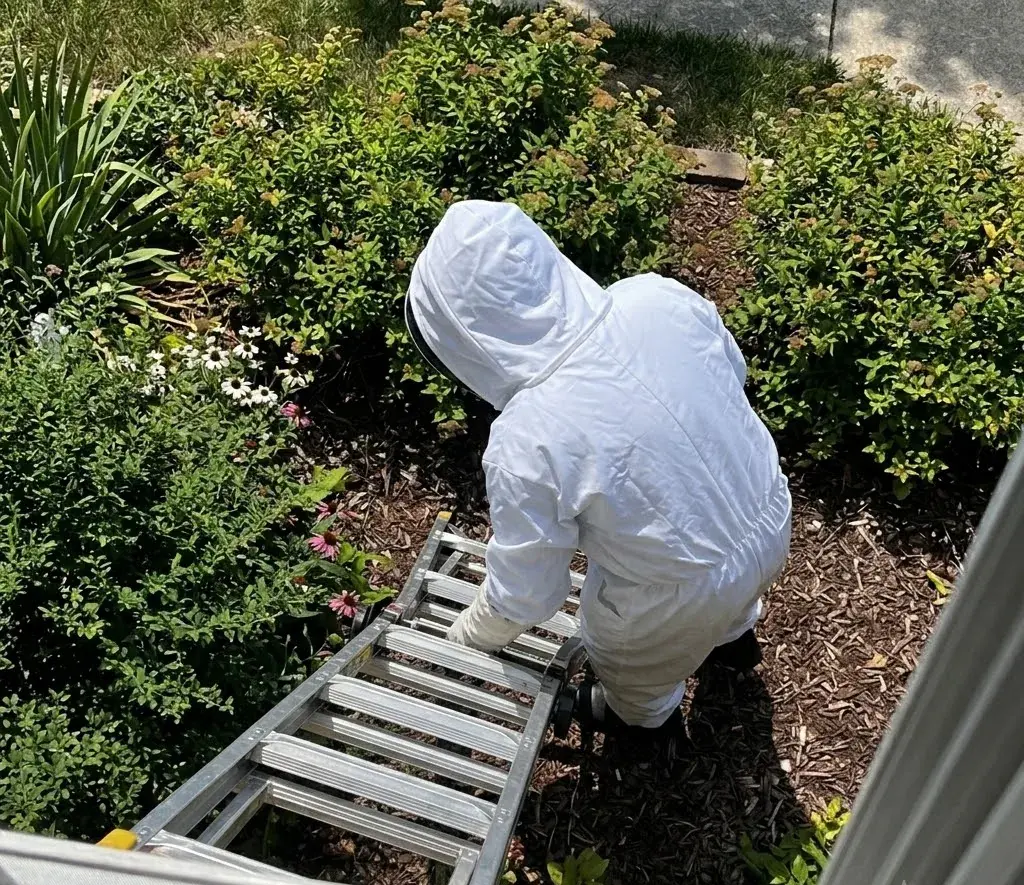
One afternoon of work on a Tallahassee house handles four separate pest problems simultaneously, and no pesticide is involved anywhere in it…
Read article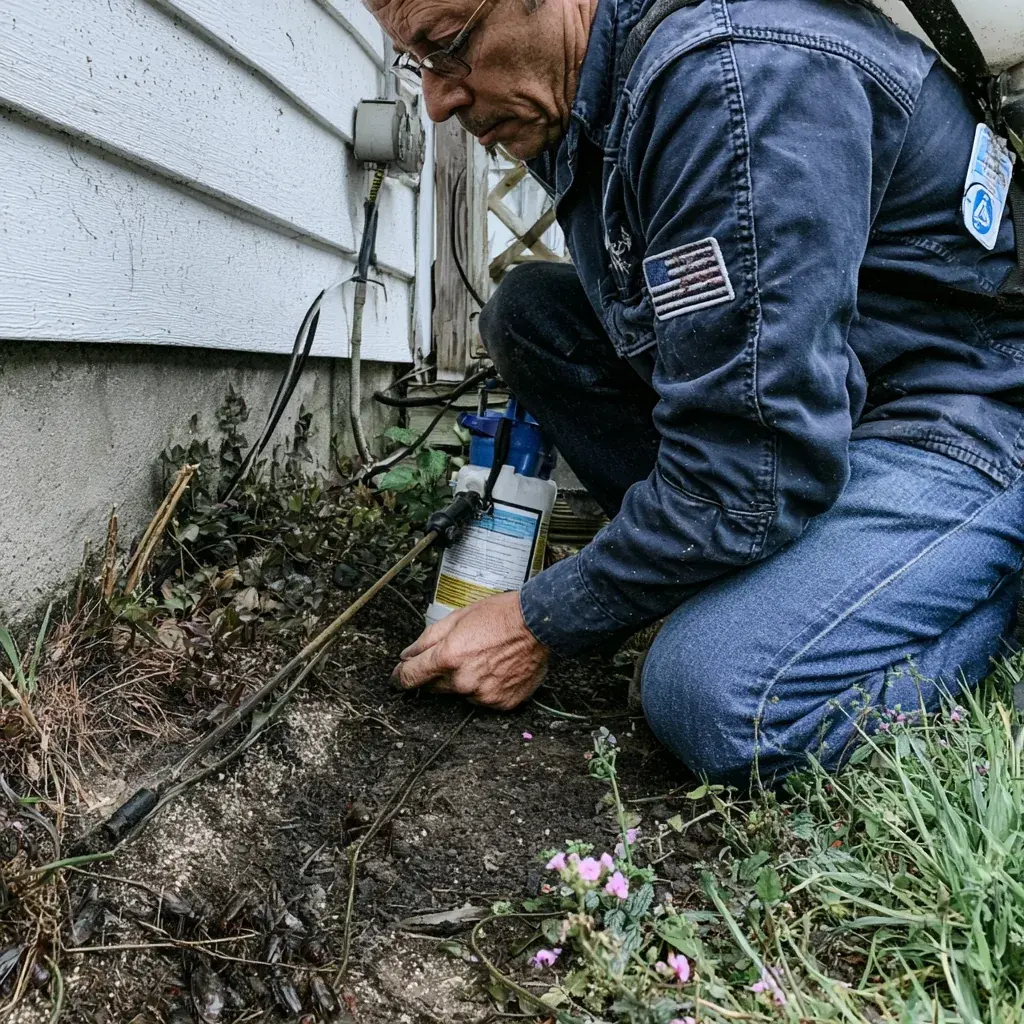
Almost all of it happens outdoors, in the eighteen inches of ground nobody ever looks at.
Most of the work on a sound pest program happens outdoors, along the narrow strip of ground where the wall meets the soil. That is where ants run their trails, where camel crickets collect under damp pine straw, and where a gap behind a downspout or a settled slab edge becomes a door. Get that line right, keep it dry, and the inside of the house stops asking for much. Red Hills clay drains fast after a storm and then holds damp underneath the mulch, the boards and the bottom course of brick, which is exactly the band nobody looks at.
Indoors the useful work is small and specific. A bait placement inside the sink cabinet, a treated crack behind the dishwasher, a monitor on the garage wall. Fogging a living room is theater. The licensed local pros we connect you with start by walking the foundation, the crawl space vents or the slab perimeter, and the door sweeps, then put material where the insect actually travels rather than where it was last seen. Leon County housing splits close to evenly between slab on grade and crawl space, so the entry story changes street by street and the plan should change with it.
That split shows up clearly across Tallahassee's older grids and newer subdivisions alike. Closer to town near Betton Hills, slab foundations sit low along the Betton branch creeks, where damp soil keeps ants and termites working the perimeter year-round. Out toward Killearn Estates, crawl space homes near Shannon Lakes and Lake Killarney deal with humidity finding its way through vents the moment temperatures climb. Further out in Bradfordville, houses along Meridian Road and the Bradfordville branch creeks face the same pressure from wooded lots pressing right up against the foundation line.
South of town, the ground shifts fast: down Woodville Highway toward Woodville, homes near Lake Munson and Munson Slough sit on soil that stays saturated well past storm season, giving foundation lines nowhere dry to settle. The same holds along Fisher Creek, where low-lying lots feed moisture straight into crawl spaces and slab edges alike. Closer to Tallahassee proper, that pattern repeats wherever runoff has nowhere to go, which is exactly the setup the licensed pros we connect you with are trained to check first.
We run general pest control right across Leon County, whether you're in Killearn Estates, Bradfordville, Midtown, or elsewhere around Tallahassee. Sandy fill, wood sitting close to grade and water standing in a low corner after a thunderstorm are what keep odorous house ants going in this part of Florida, so those are what the work is aimed at.
The treatment is the same either way. The scheduling and the paperwork are not: residential pest control for a home, commercial pest control for anywhere with customers or tenants in it.
One or two indoors is traffic and means nothing. A line following the same route along the foundation, back within a day of being sprayed, means something else: a colony with more than one queen, living outside and feeding on honeydew in the shrubs. Contact spray scatters the workers and can split it into more trails, which is why the trail keeps coming back wider than before.
The timing is the clue. American and smokybrown roaches live outdoors in mulch, gutters, sewer lines and under floors, and a storm that saturates the ground evicts them into the driest thing nearby, which is your house. Two or three days after rain is the pattern. Sightings that keep landing in a garage or utility room are telling you the problem is the perimeter, and no amount of spraying a kitchen will touch it.
If light gets through the threshold, so does an insect, and worn sweeps account for a startling share of what ends up being treated indoors. Under this canopy there is a second version of the same fault overhead: a gutter packed with oak litter holds water against the fascia and breeds mosquitoes in about a week. Both are ten-dollar problems that get treated as pest problems for years.
Millipedes, sowbugs and camel crickets are a moisture reading in insect form, and they concentrate where the water is. One wall busy while the rest of the house is quiet almost always traces to a splash zone, a dripping spigot, or a bed that has been topped up until it slopes back toward the foundation. Which wall it is tells you more than what the insects are.
The inspection starts at the foundation and works around the structure: vents, slab edge, utility penetrations, spigots, mulch depth, downspout discharge. What is found there sets the whole plan.
A band along the foundation, eaves and soffit lines cleared of nests, and the obvious gaps closed. Sealing a gap outlasts anything sprayed over it.
Baits and crack treatments go in the cabinets, voids and utility chases where the activity is. Open floors and countertops are left alone.
You get a record of what was applied and where, plus what you should change: a sweep, a grade, a woodpile off the wall. Follow-up timing depends on the pest, not on a calendar.
A perimeter that is treated and dry does two jobs at once. It cuts the number of insects that ever reach the wall, and it removes the damp, cellulose-rich conditions that also invite termites and wood-decay fungi. That is why a general service is worth doing properly rather than as a spray around the kitchen: the same neglected band of soil feeds the small problems and the expensive one.
Structural pest control in a home falls to the FDACS Bureau of Entomology and Pest Control, which enforces the Structural Pest Control Act, Chapter 482, Florida Statutes, and the pest control rules at Chapter 5E-14, Florida Administrative Code. Certificates are issued by category, so it is fair to ask which category covers the work being proposed at your house.
Under the Florida Residential Landlord and Tenant Act, section 83.51, Florida Statutes requires a landlord to make repairs and do what is necessary to keep a rental fit and habitable, and that duty runs the whole tenancy rather than ending at move-in. It cannot be waived. Who pays for a given pest treatment still turns on the lease and the cause, so report the problem in writing, keep your copy, and keep paying rent.
Prices near Betton Hills or Killearn Estates depend on lot size, how close the home sits to Lake Jackson runoff, and what the inspection actually finds inside the crawl space.
| Guesswork | Repeat purchase | Inspection first |
|---|---|---|
| Best For | Pest control near Killearn Estates, Betton Hills, and Midtown Tallahassee homes | an estimated $75–$250 |
| Single problem now | Clay soil termite and ant patterns from Bradfordville to Southwood | an estimated $90–$360 |
| Year-round coverage | Termites and roaches around Killearn Estates and Betton Hills slab and crawl-space homes | an estimated $135–$575 |
| Long-term protection | Termite and pest coverage for homes near Lake Jackson and Killearn Estates | an estimated $215–$955 |
Termite work in Tallahassee usually costs more upfront than general pest visits, since Rule 5E-14.105 requires a written contract naming subterranean or drywood coverage before treatment starts.
Far less than most people picture, and that is the point rather than a shortcut. The first visit usually puts something in the kitchen, the bathrooms and the garage; after that the outside does the work, because that is where the insects live. A company that wants to spray through your whole interior every visit is treating the ones that already got in and leaving the hundred behind them, which is why the same call comes back every season.
It depends what you are waiting on. Ants thin out in days as bait travels back into the colony. Anything walking in from outside, which here is most of it, takes two weeks or so, because you are waiting for the outdoor population to fall as well as the indoor one. After heavy rain expect a short spike first, since a saturated yard evicts everything living in it toward your house before the numbers drop.
Termites, bed bugs, a yard full of fire ant mounds, an animal in the attic and proper mosquito work are all separate jobs with different materials and their own paperwork, and a general program that claims to cover them is overselling. What this handles is the everyday crawling and flying traffic around the structure. Anyone telling you a general plan includes termites should be asked to show you the wood-destroying organism agreement, because Florida requires one in writing.
It changes almost everything about where somebody spends their time. A slab house is entered at the plumbing penetrations, the bath trap and the joint where the concrete pulled back off the wall. A raised floor is entered at the vents, the piers and the sill, and it brings damp with it. Leon County is split fairly evenly between the two, older stock in town over crawl spaces and the newer subdivisions on slab, so both are routine and the quotes are not interchangeable.
Very little, and it goes into places neither of them can reach: inside a cabinet void, into a crack behind an appliance, along the outside of the foundation. Nothing gets sprayed across an open floor. Ask for the product name and the re-entry guidance for anything used indoors and follow the drying time you are given. Both should be written on the ticket before anybody leaves, and if they are not, ask why.
An estimated $89 to $239 for an ordinary single-family house here, with the scheduled visits after it noticeably lower, because the survey and the set-up are paid for once. Three things move it: how much perimeter there is, how easy the substructure is to actually get at, and how many seasons the problem has had to settle in. Guide figure rather than a quote, and the inspection that produces the real one costs nothing.
Almost none for routine work. Clear under the sink and pull pantry items an inch off the back wall if you can manage it, and that is genuinely it. The full empty-the-kitchen preparation belongs to a heavy German roach cleanout, and if somebody hands you that list for a general service, ask which of the two they think they are quoting.
Local knowledge beats a national script. A pro who knows Leon County's mild winters barely slow pests down, and that swarming termites near Lake Jackson or Bradfordville follow the same February-through-May pattern as the rest of the Southeast, is answering from experience, not a script written for somewhere colder.
Mild winters around Betton Hills barely slow ants, roaches or termite activity
One afternoon of work on a Tallahassee house handles four separate pest problems simultaneously, and no pesticide is involved anywhere in it…
Read article
A search box hands you ads. These are the questions that actually separate one company from another, the answers worth hanging up…
Read article
What genuinely moves a pest control price in this county, with hedged ranges and the one charge nobody remembers to ask about…
Read articleTell them what you have seen and roughly where. You get a straight answer on whether general pest control is even the right job, and a written figure if it turns out to be.
Call (850) 388-6192