These dates are not advice and they do not flex. Florida's bat maternity season runs 16 April through 14 August, and evicting or excluding bats stays prohibited statewide across the entire period under rules 68A-4.001 and 68A-9.010 of the Florida Administrative Code. Exclusion is lawful only from 15 August to 15 April. Which means that finding bats in the attic in June makes the answer to when can they be removed the middle of August. Anybody offering to seal them out next week is offering to break a rule and to kill the animals living in your roof.
Why that window is closed at all
Those months are pup-rearing season, and young bats cannot fly at all. Seal the exits while they are still up in the roost and the adults end up shut out while the pups stay shut in, which produces dead animals inside the structure, odor, and a mess within a wall or ceiling costing vastly more to put right than simply waiting would have. Preventing exactly that is why the prohibition exists.
Bats are protected, and nobody is licensed
Bats are protected in Florida, so none of this comes down to anybody's personal feelings about wildlife. What catches most people off guard is that the wildlife half of the work carries no license here whatsoever. The Fish and Wildlife Conservation Commission does not license nuisance wildlife control operators at all; it maintains a directory companies join voluntarily. So there is no certificate to ask for on the bat work itself, which leaves the questions about method and about dates carrying the entire weight. The structural half works differently: removing rodents from a building does require FDACS certification, and plenty of firms hold exactly that and have never once handled a bat job.
What legitimate work still happens inside the window
Considerably more than people assume. Inspection to confirm these are bats rather than squirrels or rats, identifying every entry point from outside, mapping where the roost actually sits, and planning the exclusion so the work can begin the moment the window reopens. Guano volume and location get assessed, and an honest scope gets written.
Interior protection makes up the other half of it. Sealing the route running from the attic into the living space, closing gaps around attic hatches, ceiling fixtures and duct penetrations, keeps the animals out of bedrooms while they stay in the attic entirely lawfully. Full exclusion follows on from 15 August.
How to tell whether it is actually bats
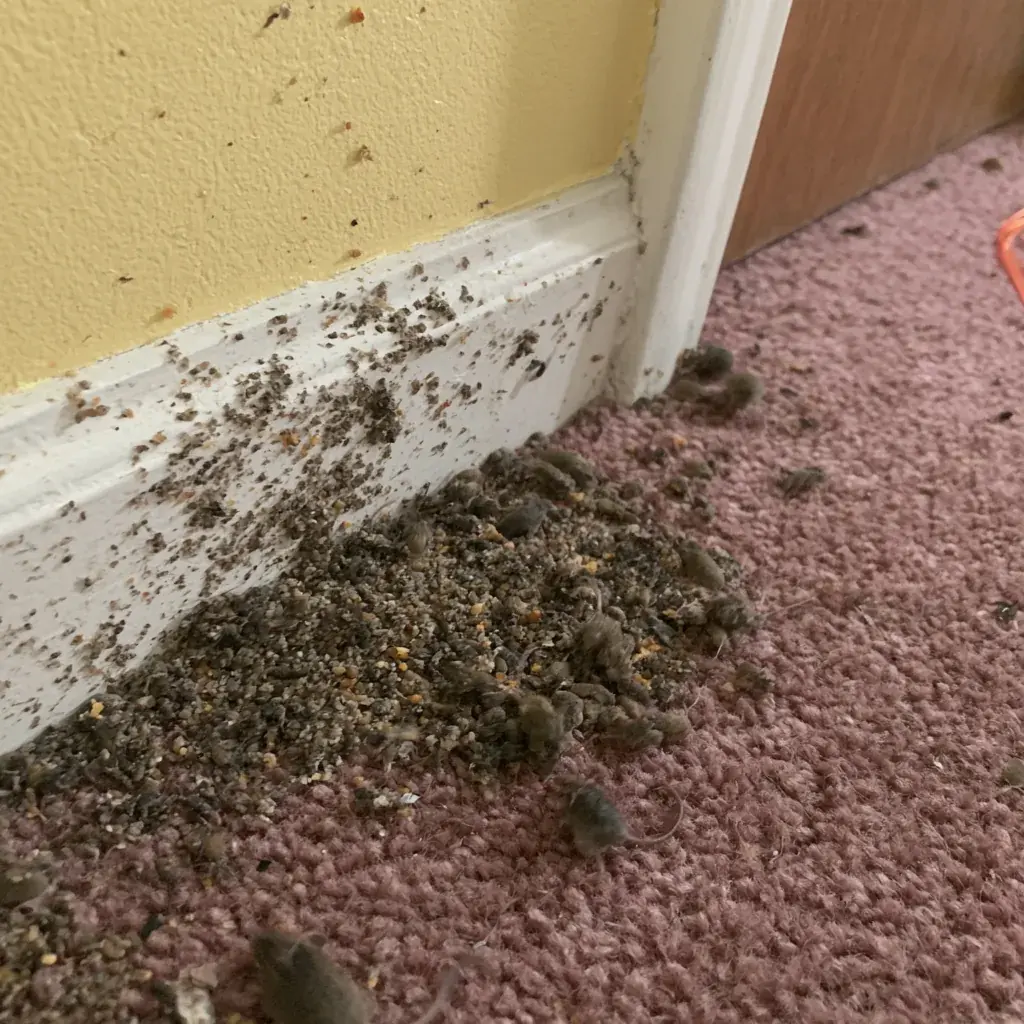
Chittering or scratching in the small hours rather than during the middle of the day. A sharp ammonia smell building steadily through the summer. Small dark droppings that crumble into shiny fragments and pile up beneath a single spot instead of scattering along a route. Greasy staining around a gap in the fascia, at a gable vent, or where a roof line meets a wall. Squirrels make their noise at dawn and dusk and chew things; rats drop along their runs rather than heaping it in one place.
Why this is never a weekend project
Not because the work is especially hard, but because both of the obvious moves are wrong ones. Sealing the gap traps animals inside, which is the entire reason those four months are closed in the first place. Climbing up there to shoo them out puts a person in contact with wildlife and with disturbed guano, and if contact with a bat does happen, that is a conversation to have with a doctor rather than something to sleep on.
Repellents, ultrasonic gadgets and mothballs will not shift a colony anywhere. What actually shifts one is a one-way exclusion device fitted to every single entry point, installed at the right time of year, and followed by proper sealing once the roost has emptied.
What the work looks like after 15 August
Exclusion devices go onto the entries so bats can get out and cannot get back in, they stay put long enough for the roost to empty completely, and then every gap gets sealed using materials that survive on a roof line. Cleanup and sanitizing of the affected area comes next, and insulation sometimes has to be pulled out entirely. That is the moment the job stops being a wildlife problem and turns into a building repair, so get the sealing scope down in writing rather than accepting it as a verbal promise.
If it is June and the bats are already there
Book the inspection now rather than in August, because every other household in the county with the same problem will be dialing on the first of that month. Get the entry points identified, get the interior sealed off from the attic, get a written scope for the exclusion, and put the work on the calendar for the first week the window reopens. Attics around Bradfordville, and in the older parts of town with open gable vents, are the usual candidates.
Dealing with this in your home?
Bed bugs travel in luggage and boxes, not seasons, so Leon County calls do not slow down each winter the way ant and roach calls do. Semester turnover near Tallahassee Community College and the moving trucks along Tennessee Street give this city its own steady source of new introductions every August and January.